
 By Alex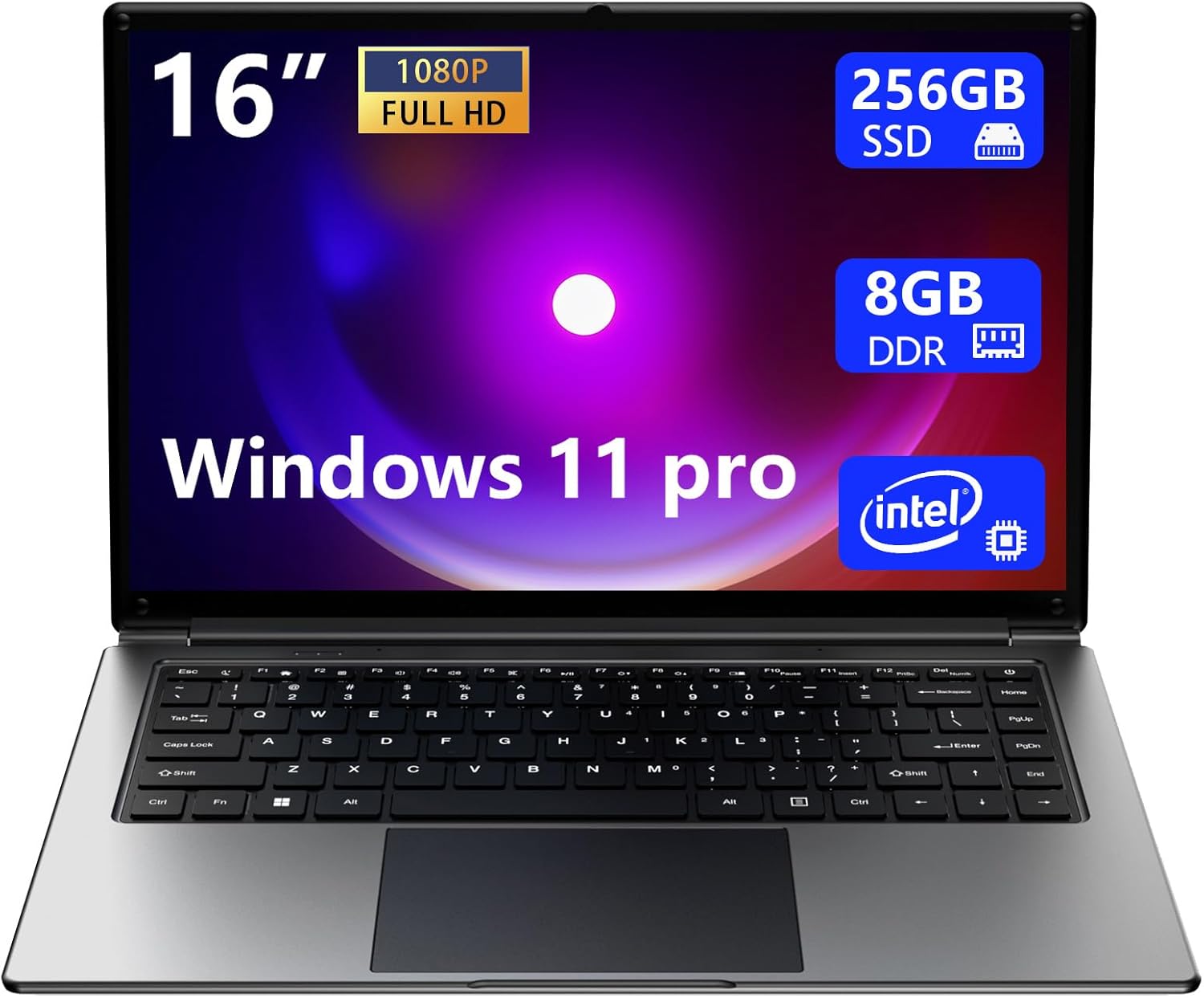


Design and build quality
This laptop emphasizes portability. The chassis measures just 1.6 cm thick and the stated weight of 1.5 kg keeps it comfortable for daily carry. The finish (Gray) looks understated and business-friendly. The hinge offers a stable viewing angle and the keyboard deck appears to be designed with a compact layout for the 16-inch form factor.
Display: large, clear, and practical
The 16-inch Full HD IPS panel delivers a crisp 1920 × 1080 canvas that is well suited for multitasking and media. IPS technology ensures wide viewing angles and accurate colors for general-purpose photo editing, streaming and document work. The 16:9 ratio is the standard cinematic format, and the ~90% screen-to-body ratio gives a modern, immersive look without making the laptop much larger overall.
Performance and everyday use
Equipped with an Intel Pentium quad-core processor that can reach a maximum of 2.64 GHz, this laptop is positioned for light to medium workloads: web browsing, office productivity, video streaming, and casual multitasking. Compared with older Celeron-class chips, the Pentium here claims a roughly 35% CPU performance increase and up to a 78% boost in integrated GPU performance — which translates into smoother web apps and better video playback.
The 8GB DDR3 RAM is adequate for standard productivity tasks. Note the DDR3 platform is an older memory generation, so heavy multitaskers or creators working with large datasets will feel the limit sooner than on machines with 16GB or DDR4/DDR5 memory. The 256GB SSD provides snappy boot times and application launches; the TF card slot provides flexible storage expansion up to 1TB for documents and media.
Battery life and mobility
A 9000mAh (listed ~38 Wh) lithium polymer battery promises long usage between charges. While exact runtime depends on brightness, workload, and network activity, expect full-day light use (web, office, video) from a single charge under optimized settings. The combination of a power-efficient Pentium CPU and an SSD helps maximize battery life versus older spinning-disk systems.
Ports, connectivity and extras
The laptop includes standard ports: multiple USB (including USB 3.0), mini HDMI for external displays, a webcam for video calls, and support for dual-band Wi‑Fi (802.11ac) and Bluetooth. These options make it a practical travel companion for presentations, remote work and connecting to peripherals. Note that the absence of a full-sized HDMI may require an adapter for some users.
Who is this laptop best for?
- Students who need a large display for reading, note-taking and media without carrying a heavy machine.
- Remote workers and professionals whose workflows are primarily web and document-based.
- Anyone seeking a secondary, portable laptop for travel and media consumption.
Limitations and caveats
•Not for heavy content creation: The Pentium CPU and 8GB DDR3 limit suitability for demanding video editing, large photo editing or heavy multitasking workflows.
•DDR3 memory: DDR3 is older memory tech; future-proofing and upgrade potential are more limited compared to DDR4/DDR5 platforms.
•Port selection: Mini HDMI instead of full-size HDMI may require adapters for some users.
What we like
•Large Full HD IPS display: Great for multitasking and watching video with accurate colors and wide viewing angles.
•Portable and light: Thin 1.6 cm body and ~1.5 kg weight make it easy to carry daily.
•Good battery capacity: 9000mAh battery combined with an efficient CPU and SSD promises strong practical battery life.
•Expandable storage: 256GB SSD plus TF card expansion up to 1TB gives flexibility for media-heavy users.
Detailed technical specifications
| Model | 16-inch Portable Laptop (Generic) |
|---|---|
| Display | 16″ IPS Full HD (1920 × 1080), 16:9, ~90% screen-to-body |
| Processor | Intel Pentium quad-core (listed as Pentium/Celeron series equivalent), up to 2.64 GHz |
| Graphics | Integrated Intel graphics (shared memory) |
| Memory | 8GB DDR3 SDRAM (maximum listed 8GB) |
| Storage | 256GB SSD — TF card expansion supported (up to 1TB) |
| Operating System | Windows 11 Pro |
| Battery | 9000mAh / ~38Wh Lithium Polymer |
| Weight & Dimensions | ~1.5 kg — 14.6″ L × 9.6″ W × 0.75″ Th (approx.) |
| Ports | USB 3.0 (x2), other USB ports (total 3 ports listed), Mini HDMI, Memory Card Slot |
| Wireless | 802.11ac dual-band Wi‑Fi, Bluetooth |
| Camera | Integrated webcam |
| Audio | HD Audio |
| Color | Gray |
| Form Factor | Clamshell |
Real-world usage notes
If your days consist of multiple browser tabs, office suites, video calls, and streaming, this laptop will handle those tasks with ease. For light photo editing and casual gaming at low settings, the integrated Intel graphics are serviceable. For 3D work, fast video rendering, or heavy virtualization, consider a laptop with a stronger CPU and more memory.
FAQ
- Can the RAM be upgraded?
- The product lists 8GB DDR3 as both installed and maximum size, which suggests RAM is either soldered or limited — confirm upgradeability with the seller/manufacturer before purchase if upgradability matters.
- How long does the battery last in real use?
- Battery runtime will vary. Under light productivity (web browsing, documents, medium brightness) expect many hours of use. Heavy workloads, high brightness or video conferencing will reduce runtime accordingly.
- Is the storage user-upgradeable?
- 256GB SSD is listed as the internal storage and there is TF card expansion up to 1TB. Internal SSD upgrade options depend on the specific internal layout — check the manufacturer’s documentation or a service manual.
- Is this suitable for students?
- Yes — the large 16″ screen, light weight and long battery life make it a practical student laptop for reading, note-taking, research, and streaming.
Notes: Specifications are compiled from the supplied product details. If you need further testing data like benchmark numbers, color gamut readings, or a full teardown, I can add that with a test unit or third-party benchmark results.